Skip to Main Content
Skip to Main Content
American Psychiatric Association
-
-
-
-
 The American Psychiatric Association Publishing Textbook of Psychosomatic Medicine and Consultation-Liaison Psychiatry
by
James L. Levenson (Editor)
As with the first two editions, this third edition of The American Psychiatric Association Publishing Textbook of Psychosomatic Medicine and Consultation-Liaison Psychiatry is the most comprehensive reference on the subspecialty available. Extensively revised and updated, this new edition also features 30 new authors. The emphasis on a diversity of perspectives remains as strong as ever: Chapter authors represent a range of backgrounds and disciplines, and of opinions and viewpoints, and 24 of the 88 contributors are from countries other than the United States. Organized into four sections, the textbook addresses * General principles of evaluation and management, legal and ethical issues, and psychological reactions to illness.* Psychiatric symptoms and disorders--including delirium, aggression, depression, suicidality, psychosis, anxiety, eating and sleep disturbances, sexual dysfunction, and substance use problems--commonly encountered in medically ill populations.* Psychological and social aspects of diseases and disorders affecting the various organ systems.* Psychiatric treatments in the medically ill, including psychopharmacology, psychotherapy, electroconvulsive and other neurostimulation therapies, and palliative care. Encyclopedic in its scope and accessible in its presentation, The American Psychiatric Association Publishing Textbook of Psychosomatic Medicine and Consultation-Liaison Psychiatry is an essential resource for psychiatry residents, psychosomatic medicine fellows, attending psychiatrists, and other specialists who need to stay up to date with the rapidly expanding evidence base in the field.
The American Psychiatric Association Publishing Textbook of Psychosomatic Medicine and Consultation-Liaison Psychiatry
by
James L. Levenson (Editor)
As with the first two editions, this third edition of The American Psychiatric Association Publishing Textbook of Psychosomatic Medicine and Consultation-Liaison Psychiatry is the most comprehensive reference on the subspecialty available. Extensively revised and updated, this new edition also features 30 new authors. The emphasis on a diversity of perspectives remains as strong as ever: Chapter authors represent a range of backgrounds and disciplines, and of opinions and viewpoints, and 24 of the 88 contributors are from countries other than the United States. Organized into four sections, the textbook addresses * General principles of evaluation and management, legal and ethical issues, and psychological reactions to illness.* Psychiatric symptoms and disorders--including delirium, aggression, depression, suicidality, psychosis, anxiety, eating and sleep disturbances, sexual dysfunction, and substance use problems--commonly encountered in medically ill populations.* Psychological and social aspects of diseases and disorders affecting the various organ systems.* Psychiatric treatments in the medically ill, including psychopharmacology, psychotherapy, electroconvulsive and other neurostimulation therapies, and palliative care. Encyclopedic in its scope and accessible in its presentation, The American Psychiatric Association Publishing Textbook of Psychosomatic Medicine and Consultation-Liaison Psychiatry is an essential resource for psychiatry residents, psychosomatic medicine fellows, attending psychiatrists, and other specialists who need to stay up to date with the rapidly expanding evidence base in the field.
ISBN: 9781615371990
Publication Date: 2019
-
 The American Psychiatric Association Publishing Textbook of Suicide Risk Assessment and Management
by
Liza H. Gold; Richard L. Frierson (Editors)
Charged with updating the preeminent text on suicide, the new editors of The American Psychiatric Association Publishing Textbook of Suicide Risk Assessment and Management opted not to simply revise existing chapters, but instead to steer a bold course, expanding, reconfiguring, and remaking the third edition to reflect the latest research, nomenclature, and clinical innovations. The editorial team and contributors--two-thirds of whom are new to this edition--have taken the intersection of suicide with both mental health and psychosocial issues as their organizing principle, exploring risk assessment and epidemiology in special populations, such as elderly patients, college students, military personnel, and the incarcerated as well as patients with a variety of psychological disorders, including bipolar spectrum, personality, depressive, anxiety, posttraumatic stress, and other disorders and schizophrenia. In addition, the book discusses treatment options (such as cognitive-behavioral therapy, dialectical behavioral therapy, and pharmacotherapy) and settings (such as emergency services, outpatient, inpatient, and civil commitment) in detail, with clinical cases to contextualize the material. The new and revised content is extensive: * A chapter on the influence of sleep and sleep disorders on suicide risk has been included that considers possible mechanisms for this link and discusses practical ways of assessing and managing sleep disorders to mitigate suicide risk.* Nonsuicidal self-injury, the prevalence of which is particularly high among youth, is addressed in detail, differentiating it from and comparing it to suicide attempts, discussing risk assessment, considering safety interventions, examining treatment options, and exploring suicide contagion.* No text on suicide would be complete without a serious exploration of the role of social media and the internet. The book presents an update on current research as it pertains to social networking and behavior, information access, and artificial intelligence and software, and includes suggestions for clinicians treating patients at risk for suicide.* Physician-assisted dying (PAD), also referred to as "aid-in-dying," is arguably a form of suicide, and the book includes a thoughtful chapter considering the ethical and practical implications of PAD, the murky professional and legal obligations that may arise, the demographics of these patients, the settings and conditions under which PAD may occur, and the role of the attendant clinicians.* A number of pedagogical features are included to help the reader learn and remember the material, including key clinical concepts and abundant case examples. Its diverse range of perspectives, broad relevance to a wide variety of clinicians, and absolutely authoritative coverage makes this new edition of The American Psychiatric Association Publishing Textbook of Suicide Risk Assessment and Management a worthy and indispensable successor.
The American Psychiatric Association Publishing Textbook of Suicide Risk Assessment and Management
by
Liza H. Gold; Richard L. Frierson (Editors)
Charged with updating the preeminent text on suicide, the new editors of The American Psychiatric Association Publishing Textbook of Suicide Risk Assessment and Management opted not to simply revise existing chapters, but instead to steer a bold course, expanding, reconfiguring, and remaking the third edition to reflect the latest research, nomenclature, and clinical innovations. The editorial team and contributors--two-thirds of whom are new to this edition--have taken the intersection of suicide with both mental health and psychosocial issues as their organizing principle, exploring risk assessment and epidemiology in special populations, such as elderly patients, college students, military personnel, and the incarcerated as well as patients with a variety of psychological disorders, including bipolar spectrum, personality, depressive, anxiety, posttraumatic stress, and other disorders and schizophrenia. In addition, the book discusses treatment options (such as cognitive-behavioral therapy, dialectical behavioral therapy, and pharmacotherapy) and settings (such as emergency services, outpatient, inpatient, and civil commitment) in detail, with clinical cases to contextualize the material. The new and revised content is extensive: * A chapter on the influence of sleep and sleep disorders on suicide risk has been included that considers possible mechanisms for this link and discusses practical ways of assessing and managing sleep disorders to mitigate suicide risk.* Nonsuicidal self-injury, the prevalence of which is particularly high among youth, is addressed in detail, differentiating it from and comparing it to suicide attempts, discussing risk assessment, considering safety interventions, examining treatment options, and exploring suicide contagion.* No text on suicide would be complete without a serious exploration of the role of social media and the internet. The book presents an update on current research as it pertains to social networking and behavior, information access, and artificial intelligence and software, and includes suggestions for clinicians treating patients at risk for suicide.* Physician-assisted dying (PAD), also referred to as "aid-in-dying," is arguably a form of suicide, and the book includes a thoughtful chapter considering the ethical and practical implications of PAD, the murky professional and legal obligations that may arise, the demographics of these patients, the settings and conditions under which PAD may occur, and the role of the attendant clinicians.* A number of pedagogical features are included to help the reader learn and remember the material, including key clinical concepts and abundant case examples. Its diverse range of perspectives, broad relevance to a wide variety of clinicians, and absolutely authoritative coverage makes this new edition of The American Psychiatric Association Publishing Textbook of Suicide Risk Assessment and Management a worthy and indispensable successor.
ISBN: 1615372849
Publication Date: 2020
-
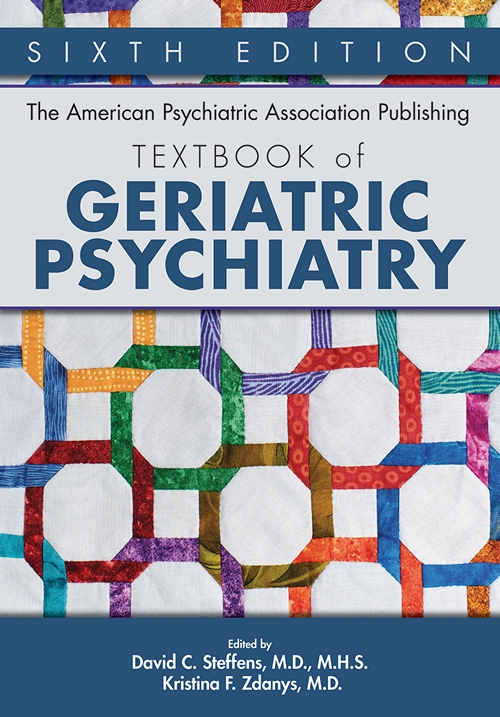 The American Psychiatric Association Publishing Textbook of Geriatric Psychiatry, Sixth Edition
by
Steffens, David C.& Zdanys, Kristina (Editors)
"This new edition retains the multidisciplinary and developmental perspectives of its predecessors, drawing on the knowledge not only of psychiatrists but also of relevant biomedical and behavioral experts in order to present the most comprehensive approach to patient care. It has been extensively updated to reflect the latest scientific advances and clinical developments in the field. Not only will readers find the most up-to-date information on phenomenology, diagnosis, and assessment of late-life mental disorders, they will also access the latest research on psychotherapeutic, psychopharmacological, and other somatic treatments. A dedicated chapter delves into the role of technology-including digital phenotyping, wearables, digital and web-based neurocognitive testing, and more-in aiding the geriatric mental health workforce and improving both access to care and ongoing support. Throughout the book, several sections examine the impact of COVID-19, and its attendant social isolation, on older adult mental health and the evolution of treatment approaches, revealing insights learned about telepsychiatry and care in nursing homes during the pandemic. Chapters on the legal and ethical factors in the psychiatric care of older adults close out the book, the most exhaustive on the topic. Extensively researched and with key points for ease of reference, this edition will equip both the scholar and the clinician with the current state of scientific understanding as well as the practical skills and knowledge base required for dealing with mental disorders in late life"
The American Psychiatric Association Publishing Textbook of Geriatric Psychiatry, Sixth Edition
by
Steffens, David C.& Zdanys, Kristina (Editors)
"This new edition retains the multidisciplinary and developmental perspectives of its predecessors, drawing on the knowledge not only of psychiatrists but also of relevant biomedical and behavioral experts in order to present the most comprehensive approach to patient care. It has been extensively updated to reflect the latest scientific advances and clinical developments in the field. Not only will readers find the most up-to-date information on phenomenology, diagnosis, and assessment of late-life mental disorders, they will also access the latest research on psychotherapeutic, psychopharmacological, and other somatic treatments. A dedicated chapter delves into the role of technology-including digital phenotyping, wearables, digital and web-based neurocognitive testing, and more-in aiding the geriatric mental health workforce and improving both access to care and ongoing support. Throughout the book, several sections examine the impact of COVID-19, and its attendant social isolation, on older adult mental health and the evolution of treatment approaches, revealing insights learned about telepsychiatry and care in nursing homes during the pandemic. Chapters on the legal and ethical factors in the psychiatric care of older adults close out the book, the most exhaustive on the topic. Extensively researched and with key points for ease of reference, this edition will equip both the scholar and the clinician with the current state of scientific understanding as well as the practical skills and knowledge base required for dealing with mental disorders in late life"
Publication Date: 2023
 The American Psychiatric Association Publishing Textbook Of Forensic Psychiatry
by
ISBN: 9781615371914Publication Date: 2018
The American Psychiatric Association Publishing Textbook Of Forensic Psychiatry
by
ISBN: 9781615371914Publication Date: 2018 The American Psychiatric Association Publishing Textbook Of Psychiatry
by
ISBN: 1615372989Publication Date: 2019
The American Psychiatric Association Publishing Textbook Of Psychiatry
by
ISBN: 1615372989Publication Date: 2019

